
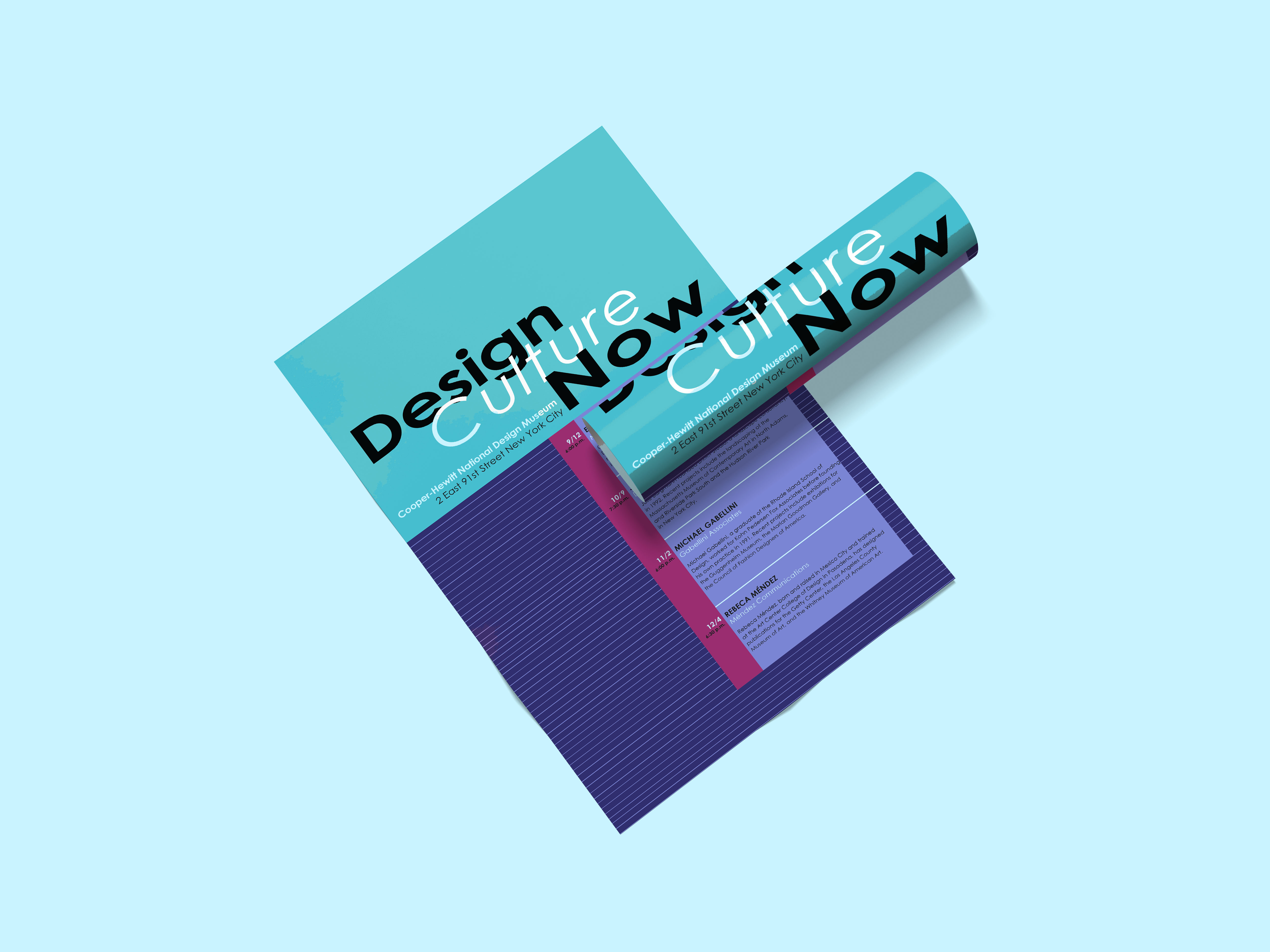
TL;DR: I designed a poster for Design Culture Now with typographic hierarchy in mind.
Design Culture Now is a fictional speaker event that takes place at theCooper Hewitt National Design Museum in New York City. It features four speakers: Erik Adigard of McShane Adigard Design, Julie Bargmann of D.I.R.T Studio, Michael Gabellini of Gabellini Associates, and Rebeca Méndez of Méndez Communications. The original poster for the event was created by Ellen Lupton, and has since become a design exercise for graphic design and typography classes all over the world. The aim of this project is to create a variation of the Design Culture Now poster using typographic hierarchy.
Lupton’s original poster was, though legible, slightly hard for me to read and follow, as the graphical elements seemingly overwhelm the entire poster. Therefore, I wanted to create a poster that was clean, organized, and easy to read and follow, along with showing significant hierarchy for the different types.
With the type, I tried to make the text interact with each other in some way. The entire poster was made using the Century Gothic font. “Design Culture Now” was made big to give it the most presence, as it is the title. Century Gothic Bold was used on “Design” and “Now,” while Century Gothic Italic was used for “Culture” to add more variation and interest for the poster. The title is then staggered downwards to add movement and allow the audience’s eyes to follow the text to the address and the speakers. The address was made smaller than the title, but with “Cooper-Hewitt National Design Museum” bolded and white to draw the eye and emphasize importance, while the actual address itself remained more neutral. It was placed underneath “Design Culture Now” so the audience can further follow the address down to the speakers. The speakers’ names are black and bolded, drawing emphasis and importance, while the names of the organizations are in white and in regular text face, making them subordinate. The same treatment is added to the dates, with only the colors swapping. The body copy (descriptions of the speakers) is in a smaller font size, making it the most subordinate of all the type presented. White lines are then added between speakers, adding structure to the poster. The background graphic consists of the top third of the poster being blue, while the bottom two-thirds are a dark purple, which was done to separate the title and address from the speakers and dates. Many lavender lines are then added to the dark purple section to add a texture to the poster and bring emphasis to the white lines separating the speakers.
Below is a WIP version of the poster.
.PNG)
Ask me anything! Or maybe tell me a story or a joke! I'm all ears!
.png)